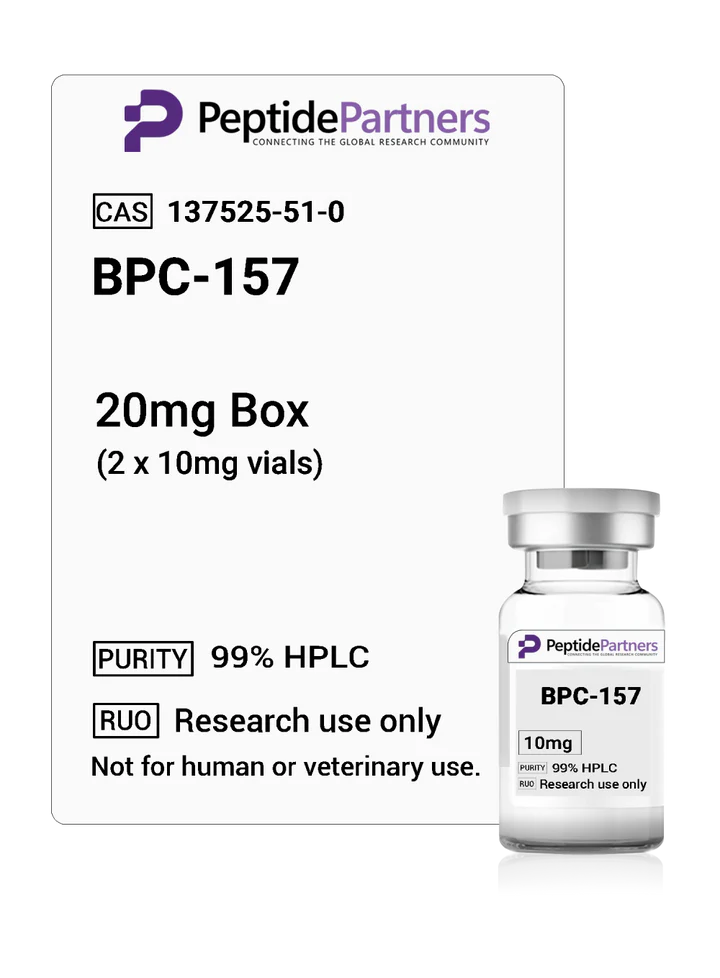
BPC-157 (10mg vials)
Price range: $106.00 through $780.00
-
Research peptide: BPC-157.
-
Research focus: Cellular signaling, tendon-fibroblast biology, angiogenesis models, endothelial function, and vascular research.
-
Format: 10 mg vials with 3 mL vial capacity.
-
Available box combinations: 20 mg, 50 mg, 100 mg, and 200 mg.
-
Purity: 99.66% multi-vial purity.
-
Testing status: Doubly validated and independently tested; purity screening passed.
-
Batch details: Manufacturer ID VI32; batch BC202604.
-
Research context: Published studies have examined growth-hormone-receptor expression, VEGFR2 signaling, endothelial tube formation, nitric oxide production, and vascular-cell responses in laboratory and animal models.
- Independent certificate details, manufacturer IDs, and batch IDs should be reviewed before purchase when available.
- Order cancellations for full refunds are available before shipment; shipped orders cannot be cancelled or refunded.
- For damaged or incorrect goods, photograph the outer packaging, inner packaging, and product labels, then email support within 48 hours of carrier delivery.
Buy BPC-157 – Peptide Partners
Product Overview & Specifications
BPC-157 is a synthetic research peptide supplied by Peptide Partners for in-vitro testing, laboratory experimentation, and preclinical research. Current research has examined BPC-157 in cellular systems and animal models involving tendon fibroblasts, endothelial signaling, angiogenesis-related assays, vasomotor responses, and nitric oxide pathways.
Research findings involving BPC-157 include changes in growth hormone receptor expression, VEGFR2-related signaling, endothelial tube formation, Src-Caveolin-1-eNOS activity, and nitric oxide production. These findings are limited to laboratory and preclinical models and do not establish human safety, efficacy, or clinical outcomes.
Product Specifications
| Specification | Details |
|---|---|
| Product name | BPC-157 |
| Compound type | Synthetic research peptide |
| Primary research areas | Cellular signaling, tendon-fibroblast biology, endothelial research, angiogenesis models, and vascular biology |
| Product format | 10 mg vials |
| Vial size | 10 mg |
| Vial capacity | 3 mL |
| Available box combinations | 20 mg, 50 mg, 100 mg, and 200 mg |
| Multi-vial purity | 99.66% |
| Validation | Doubly validated |
| Independent testing | Yes |
| Purity screening | Passed |
| Manufacturer ID | VI32 |
| Batch ID | BC202604 |
| Cost per milligram | $3.90–$5.30 |
The stated 99.66% purity is based on multi-vial testing. Researchers should review the applicable batch documentation and certificate of analysis before beginning any experiment.
Primary Research Studies & Findings
Pentadecapeptide BPC 157 Enhances the Growth Hormone Receptor Expression in Tendon Fibroblasts
Authors: Chung-Hsun Chang, Wen-Chung Tsai, Ya-Hui Hsu, and Jong-Hwei Su Pang
Publication source: Molecules, 2014;19(11):19066
Reference: View publication
This in-vitro study investigated BPC-157 in rat Achilles tendon fibroblasts. The researchers evaluated growth hormone receptor expression at the messenger RNA and protein levels, as well as cell-proliferation markers and downstream signaling activity.
The study reported dose- and time-dependent changes in growth hormone receptor expression following BPC-157 exposure. In the experimental system, the addition of growth hormone to BPC-157-treated fibroblasts was associated with increased cell-proliferation measurements and activation of Janus kinase 2 (JAK2), a downstream component of growth hormone receptor signaling.
Plain-English Research Summary
This laboratory study examined how BPC-157 affects tendon-derived cells. The researchers observed changes in growth hormone receptor expression and related signaling when the peptide was tested in cultured fibroblasts. The results describe cellular responses in an experimental model and do not establish tissue-repair effects or clinical outcomes in humans.
Therapeutic Potential of Pro-Angiogenic BPC157 Is Associated With VEGFR2 Activation and Up-Regulation
Authors: Ming-Jer Hsieh, Hsien-Ta Liu, Chao-Nin Wang, Hsiu-Yun Huang, Yuling Lin, Yu-Shien Ko, Jong-Shyan Wang, Vincent Hung-Shu Chang, and Jong-Hwei S. Pang
Publication source: Journal of Biomedical Science, 2017
Reference: PubMed 27847966
This study examined BPC-157 in human umbilical vein endothelial cells and animal models. In vitro, the researchers evaluated endothelial tube formation, vascular endothelial growth factor receptor 2 (VEGFR2) expression, receptor internalization, and downstream Akt-eNOS signaling.
The study reported increased endothelial tube formation and changes in VEGFR2 expression following BPC-157 exposure. It also examined VEGFR2 internalization and activation of the VEGFR2-Akt-eNOS signaling pathway. Inhibition of endocytosis reduced the observed responses in the experimental system, supporting a role for receptor internalization in the signaling process.
Plain-English Research Summary
This study explored how BPC-157 affects endothelial cells in laboratory assays. The researchers examined tube-like structures and a signaling pathway involving VEGFR2, Akt, and eNOS. These findings may help characterize the peptide’s cellular mechanism in angiogenesis-related research, but they do not demonstrate therapeutic activity or human benefit.
Modulatory Effects of BPC 157 on Vasomotor Tone and the Activation of the Src-Caveolin-1-Endothelial Nitric Oxide Synthase Pathway
Authors: Ming-Jer Hsieh, Cheng-Hung Lee, Ho-Yen Chueh, Gwo-Jyh Chang, Hsiu-Yun Huang, Yuling Lin, and Jong-Hwei S. Pang
Publication source: Scientific Reports, 2020
Reference: View publication
This study investigated the effects of BPC-157 on vascular responses using isolated rat aorta and vascular endothelial-cell experiments. The researchers assessed vasomotor tone, nitric oxide production, endothelial-cell migration, and phosphorylation of Src, Caveolin-1, and endothelial nitric oxide synthase (eNOS).
The study reported concentration-dependent, endothelium-dependent vasodilation in isolated rat aorta. In endothelial-cell experiments, BPC-157 was associated with increased nitric oxide production and cell migration. Additional analyses indicated that the Src-Caveolin-1-eNOS signaling pathway was involved in the observed responses, while Src inhibition reduced those effects.
Plain-English Research Summary
This research examined how BPC-157 influences vascular-cell signaling in isolated tissues and laboratory cell systems. The study focused on nitric oxide production and the Src-Caveolin-1-eNOS pathway, which are relevant to endothelial biology. The results are mechanistic and preclinical and should not be interpreted as evidence of a human vascular or healing treatment effect.
Standard Research Disclaimer
Research Use Only. Not for use in diagnostic tests.
This product is solely intended for research purposes as a chemical compound. It is designated exclusively for in-vitro testing and laboratory experimentation. All information provided about this product is educational and should be evaluated by appropriately qualified research personnel.
By law, bodily introduction of this product into humans or animals is strictly prohibited. This compound must not be used, administered, or represented as a drug, food, dietary supplement, cosmetic, diagnostic material, or medical treatment. It is not intended to diagnose, treat, cure, or prevent any disease. It should be handled only by licensed and qualified professionals in an appropriately equipped laboratory and in accordance with applicable laws, institutional procedures, and relevant safety requirements.
| Choose pack |
2 vials × 10mg (20mg total) ,5 vials × 10mg (50mg total) ,10 vials × 10mg (100mg total) ,20 vials × 10mg (200mg total) |
|---|
- All of our manufacturing partners produce peptides using the Lyophilization (Freeze Drying) process, ensuring products maintain stability for shipping and storage for 12+ months.
- In lyophilized form, they are shelf-stable for many weeks. However, for long-term storage, it is recommended to store them in the freezer.
- We often hear concerns about the standard "discard after 28 days of first use" disclaimer. Don't worry, this has nothing to do with studies regarding the efficacy of specific peptides. 28 days is the FDA requirement for producers of multi-use vials to prove their bacteriostatic maintains efficacy. This minimum requirement becomes the de facto standard.
- In our experience, if you use proper sterile procedures and refrigerated storage, you can continue sampling from the same reconstituted vial for 3+ months.
Certificate records
No published certificate records are available for this product.
Search Certificate LedgerRelated products
Combo Vial: BPC-157/TB-500 (20mg vials)
Price range: $224.00 through $880.00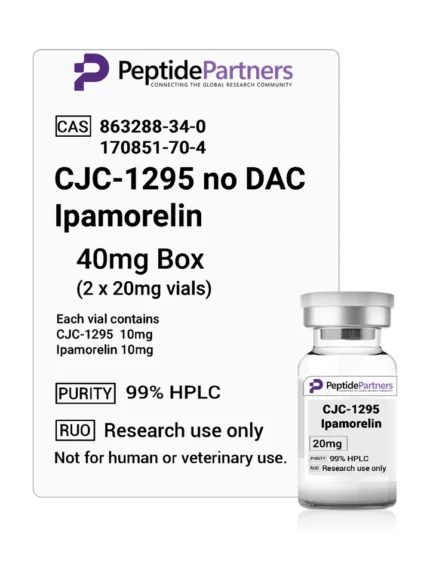
Combo Vial: CJC-1295 no DAC/Ipamorelin (20mg vials)
Price range: $220.00 through $877.00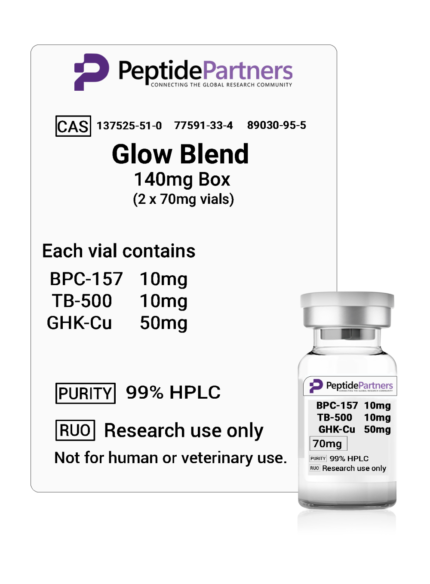
GLOW Blend: BPC-157/TB-500/GHK-Cu (70mg vials)
Price range: $182.00 through $770.00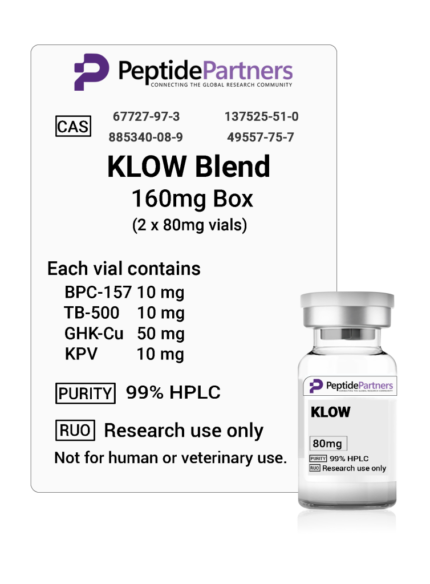
KLOW Blend: BPC-157/TB-500/GHK-Cu/KPV (80mg vials)
Price range: $240.00 through $975.00
KPV (10mg vials)
Price range: $88.00 through $320.00